Movement & Power · Seville · Atlantic · PeruPublished 22 August 2026
How Did the Olive Tree Reach Peru?
The best-known account begins with Antonio de Ribera, more than one hundred olive cuttings from Seville, and only three surviving the journey to Peru. The documentary trail is both stronger and less tidy than the legend.
The story is usually told as a beginning.
Around 1560, Antonio de Ribera returned to Peru from Spain carrying olive cuttings. Most died on the crossing. A few survived. From those few plants, the olive established itself on the Peruvian coast.
The outline is plausible and unusually vivid.
It is also a story assembled from sources written at different distances from the event.
That distinction matters.
The short answer
The strongest currently verified account comes from Inca Garcilaso de la Vega, published in 1609.
Garcilaso says that Antonio de Ribera brought more than one hundred olive cuttings from Seville to Peru and that only three arrived alive.
That gives us a named person, a place of origin, an approximate date, and a striking measure of how difficult the transfer was.
It does not give us a complete shipping record.
The surviving evidence currently supports Seville more securely than the more specific claim that Ribera's cuttings came from the Aljarafe, the olive-growing territory immediately west of the city.
That narrower provenance remains under investigation.
Before Ribera, there were no olive groves in Peru
Seven years before the date traditionally associated with Ribera's successful introduction, the chronicler Pedro Cieza de León described a landscape still waiting for the olive.
In his Crónica del Perú, published in 1553, Cieza wrote that olives had not yet been brought to Peru.
What makes the passage especially interesting is what he says next.
He thought they should thrive there.
Looking at the Peruvian coast, its climate, and its access to water, Cieza imagined that it could eventually support large olive groves comparable to those of the Aljarafe outside Seville.
The comparison existed before the grove.
Peru did not yet have the olive tree, but a Spanish observer was already reading parts of the coast through an Andalusian agricultural landscape.
Garcilaso's account
Garcilaso's version appears more than four decades after the reported transfer.
He attributes the introduction to Antonio de Ribera and places it in 1560.
According to his account, Ribera carried more than one hundred olive cuttings from Seville. Only three living stakes survived the journey.
Garcilaso then tells a much more elaborate story.
The surviving plants were guarded closely. One was stolen. Material from the stolen tree eventually helped carry the olive farther south. Notices threatening excommunication were supposedly used in the attempt to recover it.
It is a memorable sequence, which is precisely why it has been repeated so often.
For the purposes of this project, however, the important starting point is narrower.
Garcilaso gives us the strongest currently verified early statement that Ribera brought olive plants from Seville and that the overwhelming majority failed to survive the crossing.
The more colorful parts of the story deserve separate verification rather than automatic repetition.
Antonio de Ribera was actually in Spain
One reason to take the basic chronology seriously is that Antonio de Ribera can be found outside the later olive narratives.
A royal letter dated 5 September 1556 refers to Ribera having already come to the royal court carrying powers from councils and towns in Peru.
Records in the Archivo General de Indias also place Ribera and his wife, Inés Muñoz, in legal proceedings before the Council of the Indies toward the end of 1556.
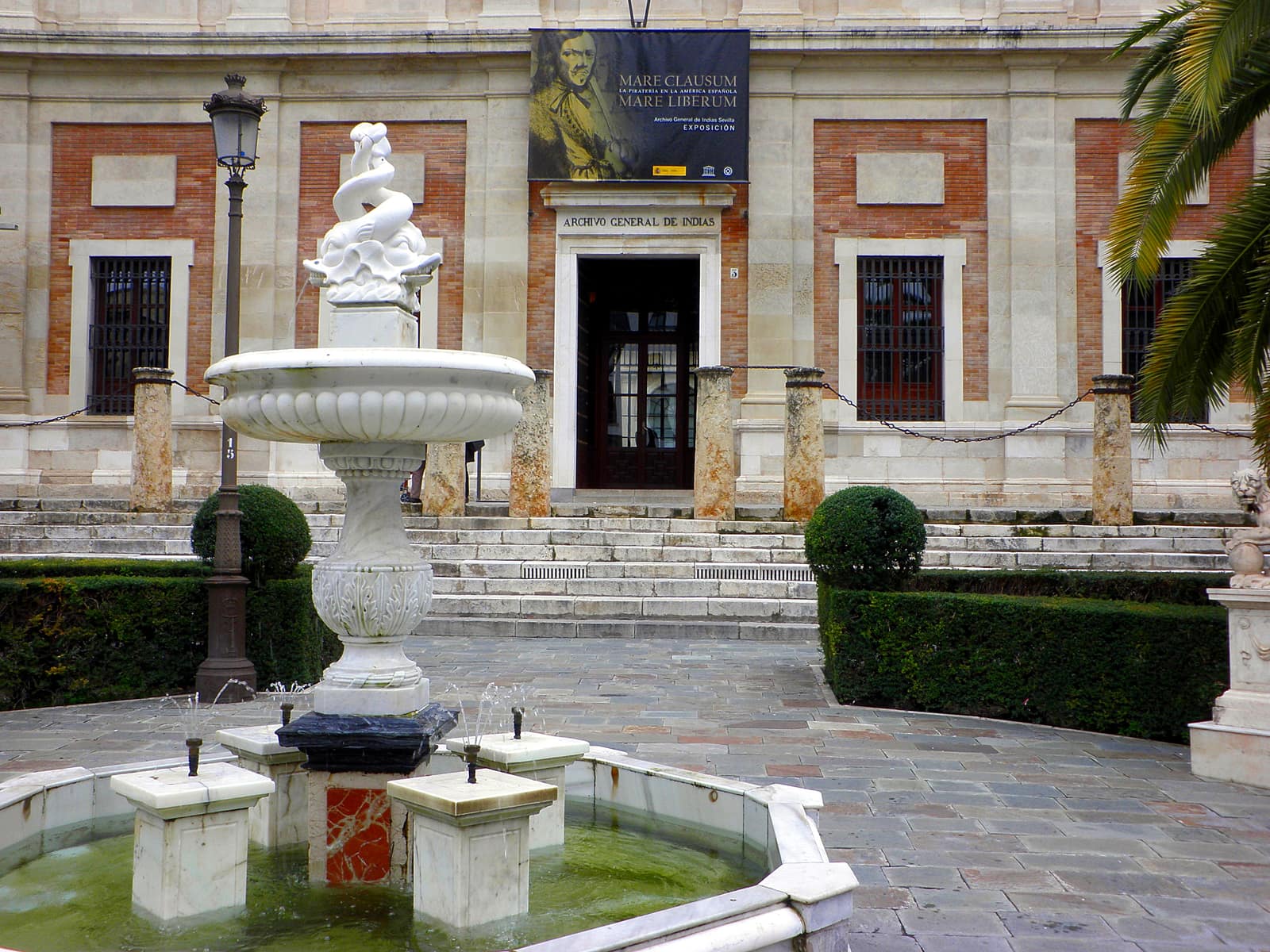
Archivo General de Indias, SevilleEmilio J. Rodríguez PosadaCC BY-SA 2.0
These documents do not say that he was carrying olive trees.
They do something more limited but important: they establish that Ribera's presence in Spain in the years preceding the reported introduction was real, not merely part of a later agricultural legend.
The next step is to reconstruct his movements more precisely.
Passenger records, licences, Casa de Contratación material, cargo documentation, and correspondence may yet narrow the route between Spain and Peru.
Was the olive from Seville or from the Aljarafe?
This is where a simple story becomes less certain.
Garcilaso's wording points to Seville.
Later traditions become more specific and identify the Aljarafe, the productive agricultural territory on the western side of Seville whose olive groves had supplied the city for centuries.
That provenance is entirely plausible.
The Aljarafe was deeply connected to Seville's food supply, olive production, and Atlantic economy. Documentary work also shows that the Spanish imperial system had been attempting to move vines and olive propagation material across the Atlantic decades before Ribera's reported journey.
But plausibility is not provenance.
A transmitted passage attributed to the seventeenth-century Jesuit chronicler Bernabé Cobo places the cuttings in the Aljarafe. The textual history of that phrase still needs to be checked against manuscript evidence to establish whether the wording belongs to Cobo himself, an annotation, or a later editorial intervention.
Other later compilations repeat the Aljarafe connection without resolving the genealogy of the claim.
For now, the careful formulation is simple:
Seville is supported by Garcilaso. The Aljarafe is a strong lead, not yet a closed case.
This was not the first attempt to move olive trees across the Atlantic
Ribera's story is often told as if one determined traveler independently decided to bring an olive tree to Peru.
The surrounding history is larger.
Research on the colonial olive trade shows that the Casa de Contratación and the Crown had already been involved in attempts to transport useful plants from Spain to the Americas.
Records from the early sixteenth century include purchases of olive propagation material in the Aljarafe and instructions concerning the transport of vines and olives.
That does not prove a direct botanical line from those earlier shipments to Ribera's plants.
It does change the frame.
Moving a living tree across the Atlantic was not merely an act of personal curiosity. It belonged to an expanding imperial infrastructure for moving organisms, crops, knowledge, and productive capacity between continents.
Whether a particular plant survived was another question.
What we can say with confidence
By 1553, Cieza de León could still describe olives as absent from Peru while predicting that the coast could support them.
In 1609, Garcilaso attributed their successful introduction to Antonio de Ribera around 1560 and said that Ribera carried more than one hundred olive cuttings from Seville, of which only three survived.
Independent sixteenth-century records confirm that Ribera was in Spain during the years preceding that reported transfer.
Olive cultivation subsequently became established in Peru.
The broad sequence is therefore well supported.
Its finer details are still being reconstructed.
What remains uncertain
Several apparently simple questions remain open.
Where exactly did Ribera obtain the cuttings?
Seville is currently the strongest verified answer. The more specific Aljarafe provenance requires further textual and archival confirmation.
What ship carried them?
Not yet established.
What route did Ribera take back to Peru?
Not yet reconstructed with sufficient confidence.
Were the three surviving cuttings literally the biological origin of Peru's later olive population?
The historical narrative says so, but genetic and propagation history is more complicated than a founding legend can capture.
How much of Garcilaso's theft-and-recovery story can be independently corroborated?
Still under investigation.
Those uncertainties do not weaken the story.
They tell us where the archival work begins.
Source trail
Primary sources
Pedro Cieza de León, Crónica del Perú (1553).
Chapter CXIII contains the pre-introduction passage describing olives as not yet established in Peru and comparing the coast's potential with the Aljarafe.
Cieza de León, Crónica del Perú (PDF)
Inca Garcilaso de la Vega, Comentarios Reales de los Incas (1609).
The principal currently verified narrative source for Antonio de Ribera, the Seville provenance, more than one hundred cuttings, and three surviving stakes.
Garcilaso de la Vega, Comentarios reales (PDF)
Philip II / Council of the Indies, royal letter concerning Antonio de Ribera, 5 September 1556.
Contemporary evidence that Ribera had already travelled to the royal court on behalf of Peruvian councils and towns.
Archivo General de Indias, Antonio de Ribera contra Garci Pérez, 1556.
AGI: JUSTICIA,400,N.1. Catalogue record documenting Ribera's legal activity in Spain late in 1556.
Archivo General de Indias catalogue record
Historical and academic sources
Miguel Molina Martínez, “El cultivo del olivo en la América colonial. Propuestas de investigación” (2015).
Useful reconstruction of the wider institutional movement of olive propagation material through the Spanish imperial system.
Research status
The project is currently tracing Ribera through Archivo General de Indias and Casa de Contratación records and comparing the olive passage across Garcilaso, Cobo, and later compilations.
The specific Aljarafe provenance should not be treated as closed until that textual genealogy is resolved.
About sourcing, uncertainty, and corrections: Research Standards